

If you are upgrading or assembling an RC car, one of the first things to consider is whether to use a brushed or brushless ESC. Both brushed and brushless RC car ESCs can regulate motor operation, but they differ in power output, motor speed control, and load handling. These differences affect throttle response, low-speed operation, braking control, and overall powertrain stability.
The following will delve into the performance differences between brushed and brushless RC car ESCs.
What are the Performance Differences Between Brushed and Brushless RC Car ESCs?
Throttle Response
Brushed RC car ESCs use pulse width modulation (PWM) technology to regulate the electrical energy supplied to the brushed motor to control throttle response. They are simple to operate and provide direct throttle control.
Brushless RC car ESCs use electronic switches to control the current flowing through the motor and manage electronic commutation. They support user-defined throttle curves, acceleration settings, etc., providing more precise acceleration and power output control.
Key Differences: Both types of ESCs offer sensitive throttle control, but brushless ESCs offer more customizable adjustment options.
Power Handling Capacity
The power handling capacity of an ESC is determined by its current capacity, input voltage range, internal electronics, and cooling system. The ESC must be able to meet the power demands of the connected motor and battery without exceeding its rated operating limits.
Generally, under similar performance conditions, brushless RC car ESCs offer higher power output and higher efficiency than equivalent brushed RC car ESCs. This is because they employ more efficient electronic commutation and advanced circuit design, technologies that help reduce power losses and improve efficiency.
Low-Speed Operation and Starting Performance
Low-speed control is crucial for RC crawler vehicles, technical off-road driving, and applications requiring precise vehicle handling.
Brushed ESCs, when paired with a suitable brushed motor, can provide predictable low-speed operation. This makes them the preferred choice for many entry-level users and crawler vehicle enthusiasts.
The low-speed performance of brushless RC car ESCs depends in part on whether the system is sensor-controlled or sensorless.
Sensing brushless ESCs utilize rotor position feedback to improve starting stability and reduce cogging effects. Sensorless systems estimate rotor position electronically, which can lead to uneven starting or cogging effects under certain low-speed, high-load conditions.
Key difference: Both systems support low-speed drive, but sensing brushless RC car ESCs provide additional control functionality for applications requiring smooth starting and precise operation.
Which RC Cars Use Brushed or Brushless RC Car ESCs?
Brushed ESCs, due to their simple internal design, offer easy throttle control and predictable operation, making them widely used in the following scenarios:
Entry-level RC cars: Suitable for beginners who want something simple, easy to use, and affordable.
1/16 and 1/18 scale RC cars: Commonly used in small RC models, where medium power is sufficient.
RC climbing cars: Brushed ESCs provide smooth low-speed handling, making them suitable for technical climbing and crawling.
Everyday RC models: A practical choice for recreational users who don’t require extreme speed or acceleration.
RC Cars Suitable for Brushless RC Car ESCs
Brushless RC car ESCs support higher power output, efficient operation, and sensitive throttle control. They are the preferred choice for competitive RC cars, primarily used in the following models:
1/10 scale high-performance RC cars: Suitable for users seeking higher speed and stronger acceleration.
RC cars: Brushless systems provide the power and efficiency required for competitive driving.
High-performance off-road RC cars: Suitable for demanding driving environments requiring strong power output.
Modified RC cars: A popular choice for enthusiasts who want to upgrade their vehicles for better performance.
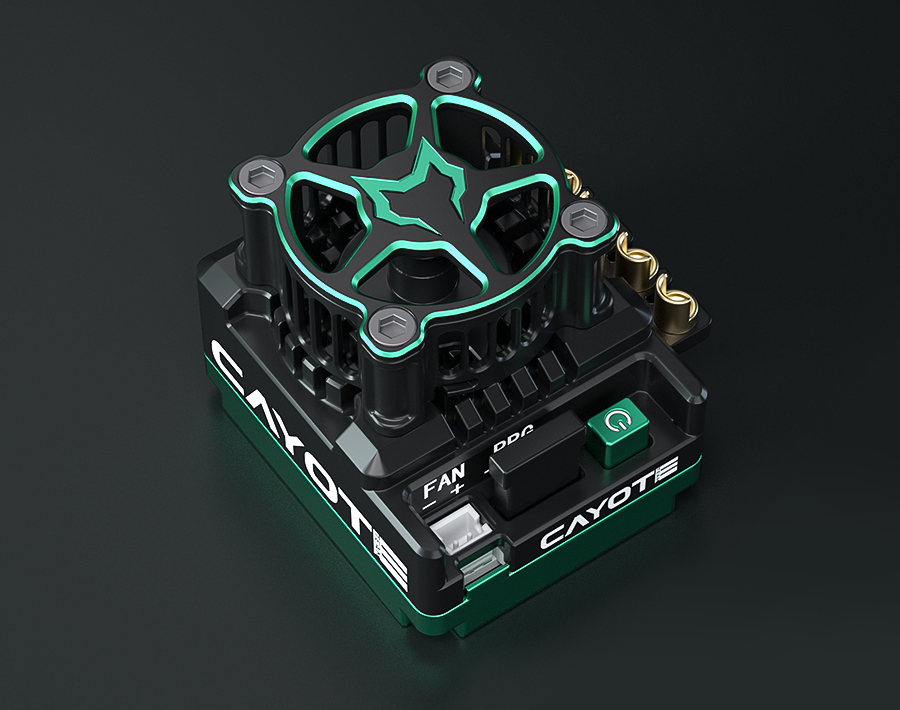
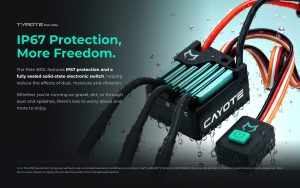
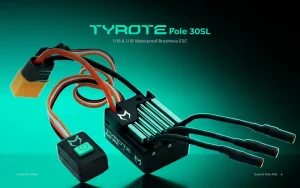
The TYROTE Pole 30SL Brushless ESC is designed for 1/16 & 1/18 RC cars, with IP67 waterproof and dustproof features, making it ideal for users looking to upgrade their small RC cars for outdoor driving.
What Factors Should RC Car Dealers Consider When Wholesaling RC Car ESCs?
For RC car dealers, offering both brushed and brushless ESC options and fully understanding their performance differences helps them expand their market and serve different customer groups.
However, when wholesaling ESCs for RC cars, distributors need to comprehensively evaluate the manufacturer’s product specifications, quality assurance, and long-term cooperation capabilities.
Electrical Specifications and Compatibility
Distributors should check the following parameters for the corresponding wholesale RC car ESCs:
Supported motor types
Continuous and peak current ratings
Supported battery voltages
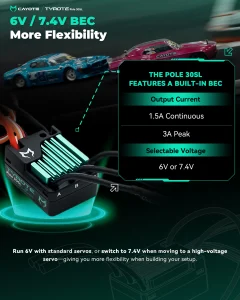
BEC output specifications
Motor and battery connector configuration
Complete and clear product parameters not only help distributors select products accurately but also reflect the manufacturer’s professionalism in product development and technical support.
Product Quality and Protection Functions
The quality of the ESC directly affects its lifespan and customer satisfaction. Distributors should evaluate the manufacturer’s quality control processes, thermal design, protection functions, and product testing information.
Focus on Evaluating the Following Aspects:
Temperature Design: Understand the MOSFETs, circuit board layout, heatsinks, and other heat dissipation structures to determine the product’s heat dissipation capabilities under continuous load.
Protection Functions: Check for overheat protection, undervoltage protection, and overcurrent protection to reduce the risk of damage.
Protection Performance: If the target market has high demands for outdoor off-road products, the ESC’s waterproof and dustproof capabilities should also be considered.
Quality Control and Testing: Understand whether the manufacturer has a comprehensive production quality control process and whether it conducts factory testing and reliability verification.
Manufacturer Supply and Technical Support
A reliable RC car power system supplier not only offers competitive prices but also excellent long-term supply capabilities and provides flexible technical upgrades, technical documentation, and after-sales support based on market developments.
CAYOTE supplies a range of RC car ESCs designed for various RC car applications, covering both brushed and brushless ESCs.
Whether you are looking for an easy-to-use ESC solution or an ESC with more advanced tuning options, CAYOTE has you covered. Please contact us for more information.