
When replacing an RC car ESC, remote control, or modifying throttle-related parameters, you need to recalibrate the ESC. Otherwise, your RC car electronic speed controller (ESC) will not function properly.
The core of calibration is to make the ESC “remember” the remote control’s throttle neutral (neutral), full throttle (maximum forward), and maximum braking positions. This allows for optimal motor performance.
Why Calibrate the RC Car ESC?
Synchronization Signal Range
Different remote controls have different PWM signal ranges and midpoint positions. Calibration ensures precise matching between the ESC and the remote control.
To Improve Handling
If the throttle ranges of the remote control and the ESC are inconsistent, it will cause inaccurate handling. After recalibration, the ESC can understand the minimum and maximum throttle values emitted by the remote control, resulting in more precise throttle control.
Ensure Smooth and Safe Driving
Calibration ensures the ESC correctly understands full brake/reverse, neutral, and full throttle positions, preventing collisions caused by signal deviations leading to motor mis-starting, incomplete zeroing, or loss of control.
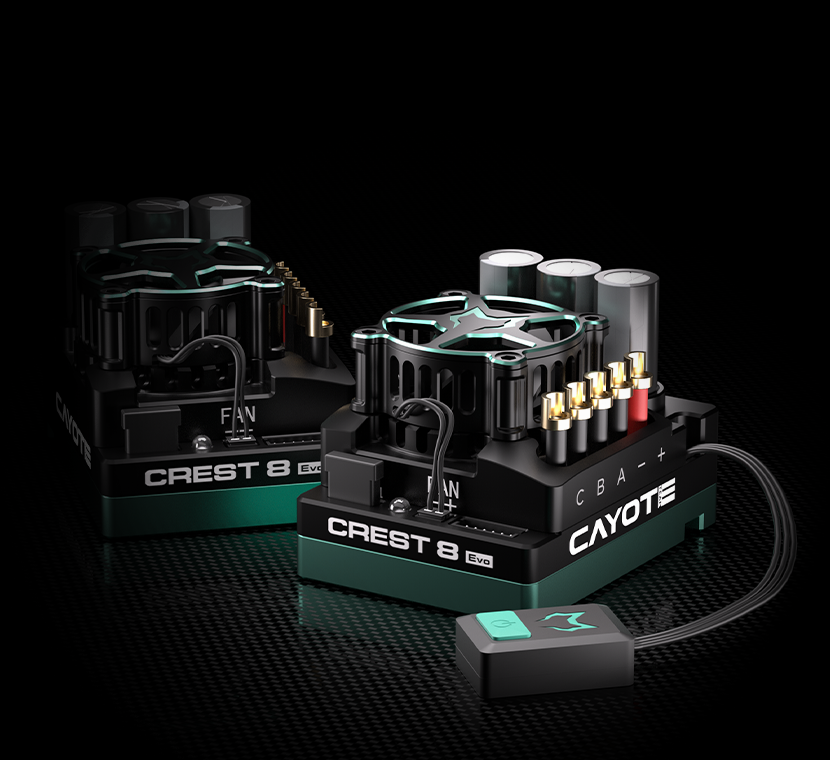
How to Calibrate the CAYOTE Racing ESC for RC Cars?
Preparations Before Calibration
Ensure Safety
It is recommended to remove the motor pinion, lift the wheels off the ground, or place the entire car on a chassis to ensure the drivetrain can rotate freely without causing the vehicle to suddenly move away.
Ensure all Equipment is Fully Charged
Ensure the RC car battery and remote control are fully charged to avoid incorrect settings due to low voltage.
Confirm Correct Wiring
Ensure the ESC is correctly connected to the battery, motor, and receiver. Insert the ESC’s three-wire cable into the receiver’s throttle channel.
Restore Remote Control to Default Settings
Turn on the remote control and set the throttle trigger to the maximum (full open) position before starting. It is also recommended to enable the “Fail Safe” function, set the remote control’s POT to “Output Off” or “Neutral Position,” ensure all parameters (such as ID, Curve, ATU) are set to their default values, and adjust the TRIM knob to the neutral position.
Power Off Before Calibration
Before starting calibration, ensure the ESC power is off. Then, follow the calibration steps to supply power.
Start Calibration of CAYOTE Racing ESC for RC Cars
Zero the Fine Adjustment: Ensure the remote control’s throttle fine adjustment is set to 0.
Enter Calibration Mode: Press and hold the power button until a beep is heard, then release.
Throttle Midpoint: Place the throttle trigger in the middle position and keep it stationary. Briefly press the power button; the ESC will beep once. Calibration is complete when in neutral.
Full Speed: Pull the throttle trigger to the maximum forward position; press the power button; the ESC will beep twice, storing the maximum forward position.
Full Brake/Reverse: Push the throttle to the maximum reverse/brake position, then press the power button once. The ESC will beep three times, indicating that the maximum brake position has been stored.
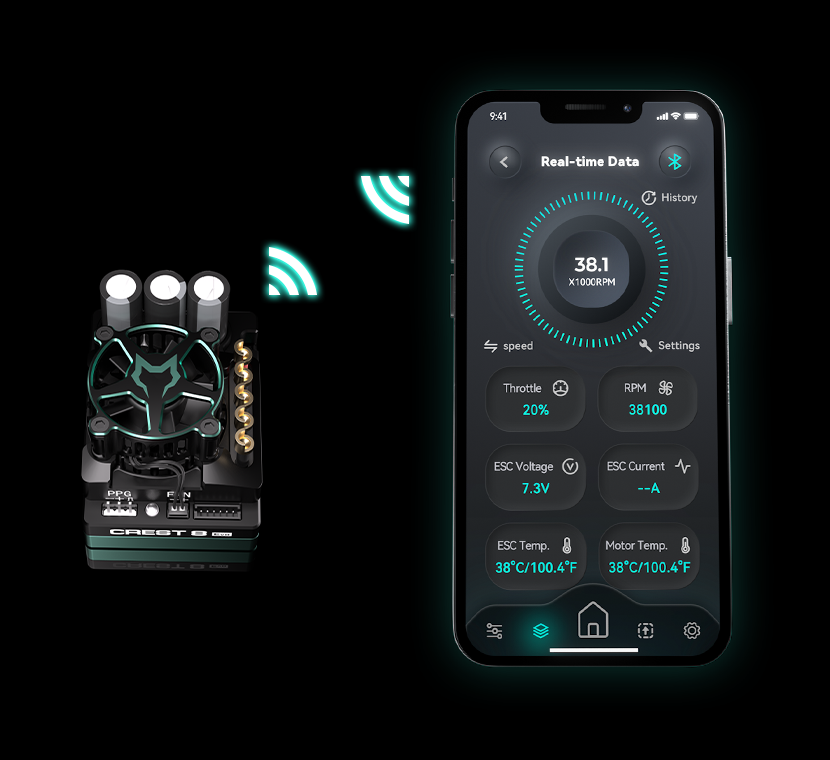
Test: Perform calibration testing using the remote control’s throttle trigger. Observe the motor and vehicle response based on the trigger operation status to confirm that the ESC correctly recognizes neutral, forward, brake, and reverse signals.
Release the throttle trigger (neutral) → The motor stops running, and the vehicle remains stationary.
Pull the throttle trigger all the way down (full throttle) → The motor reaches maximum output, and the vehicle receives maximum power.
Push the trigger to engage the brake → The motor responds to the brake, and the vehicle decelerates to a stop.
Push the trigger twice consecutively to engage reverse (if supported) → The motor reverses, and the vehicle reverses normally.
If the motor response is consistent with the throttle trigger action, without delay, malfunction, or abnormal start-up, your ESC calibration is successful.
CAYOTE professionally supplies racing ESC for RC cars, providing drivers with the ultimate control experience through stable performance and stringent quality standards. We welcome inquiries about cooperation!


Comment(01)
WOW,Very wonderful